Australian Dispute Resolution: 2025 in Review, 2026 in Focus
Contacts

Partner
Australia
I am an experienced litigation and investigations lawyer based in Sydney, leading Bird & Bird's Australian disputes and investigations practice and co-leading our global Defence and Security practice.

Senior Associate
Australia
I am a senior associate in the Dispute Resolution team in Sydney. I provide succinct, solutions orientated advice to help our clients solve complex problems, mitigate future risks and develop strategies to simplify their decision-making process.

Associate
Australia
I am an associate in the Dispute Resolution Group in Sydney, specialising predominantly in commercial disputes.
Related
Practices
Countries
Offices
In 2026, Australian businesses face changing technological innovations, regulatory reform, and societal shifts which will converge to reshape dispute resolution and litigation strategy.
From AI‑influenced courtrooms to ever‑expanding data privacy requirements, 2025 laid the foundation for a year of significant change. Among the most striking developments of the year was Australia’s pioneering approach to social‑media age limits—a reform that hints at broader, systemic shifts in how the legal system responds to digital-age challenges.
In this article, we unpack the defining trends for litigation and dispute resolution in the coming year—from the transformative role of artificial intelligence in legal practice, to heightened scrutiny around data privacy and cybersecurity, and the sweeping effects of Australia’s groundbreaking social‑media legislation.
Data/Privacy
Regulatory enforcement is set to intensify in 2026, with recent penalty proceedings underscoring a clear shift towards tougher privacy regulation. A defining moment came in October 2025, when the Federal Court issued the first ever civil penalty under the Privacy Act 1988 (Cth) (Privacy Act), ordering Australian Clinical Labs (ACL) to pay $5.8 million for a 2022 data breach that interfered with the privacy of over 223,000 individuals. Our article summarising the findings and key takeaways can be found here.
This decision represents significant escalation in privacy enforcement, signalling a new era of accountability for organisations handling personal information. The Office of the Australian Information Commissioner (OAIC) emphasised that such orders should operate as a strong deterrent—particularly now that the strengthened penalty framework under the Privacy Act is in force.
The three‑tier civil penalty regime gives the OAIC considerably expanded powers. Tier 3 penalties for serious interferences with privacy now carry maximum fines of $50 million, three times the benefit obtained, or 30% of the adjusted turnover during the relevant period.
In the January–June 2025 reporting period, the OAIC received 532 data breach notifications, with malicious or criminal attacks remaining the largest source at 59% (303 notifications). During this period, the average number of individuals affected by cyber incidents was just over 10,000. These figures highlight the scale and sophistication of current cyber threats.
Litigation risk has also intensified. High‑profile data breach class actions show that organisations now face a dual front: regulatory action and substantial private claims seeking compensation for distress, embarrassment, and the cost of responding to breaches.
On 10 June 2025, we experienced another major turning point when Australia’s statutory tort for serious invasions of privacy came into effect. This development fundamentally shifted privacy from a policy consideration to an enforceable legal right. The first application for relief under the new tort was heard on 7 October 2025 in Kurraba Group Pty Ltd & Anor v Williams [2025] NSWDC 396, in a case seeking interlocutory relief in relation to conduct alleged to be defamatory, intimidatory, and a serious invasion of privacy.
In this case, the Court found that the privacy tort applied to the use of private wedding photos which were never intended to be made public may amount to a serious invasion of privacy. Though the tort was not considered in a claim for damages, it is the first in a line of future cases which will see the statutory tort being tested and its impact on businesses carrying on activity in Australia.
With privacy now recognised as a legally enforceable right, and with regulators empowered by stronger penalty regimes, organisations should expect more privacy‑related proceedings and heightened enforcement activity in 2026.We are continuing to closely monitor developments as this rapidly evolving area of law moves further into the litigation mainstream.
Children’s Social Media Ban
As of 10 December 2025, social media platforms designated as age-restricted social media platforms (ARSMPs) under Part 4A of the Online Safety Act 2021 (Cth) — as amended by the Online Safety Amendment (Social Media Minimum Age) Act 2024 (Cth) (SMMA) — must demonstrate that they are taking "reasonable steps" to prevent Australian children under the age of 16 from maintaining accounts on their services. Non-compliance risks investigation and enforcement action by the eSafety Commissioner. Our detailed article on these obligations can be found here.
The regulatory stakes are high. Companies face significant penalties, particularly for serious or repeated breaches. Ten major platforms have been identified as age-restricted, including Facebook, Instagram, Snapchat, Threads, TikTok, Twitch, X, YouTube, Kick and Reddit.
A High Court challenge to the legislation — anticipated for some time — was announced in early December 2025. In this proceeding, the Digital Freedom Project (DFP) is supporting two 15-year-olds in a constitutional challenge to the SMMA restrictions, arguing that the regime disproportionately burdens the implied freedom of political communication. The High Court is expected to hear the case as early as February this year. Meanwhile, social media giant Reddit has filed its own High Court challenge to the SMMA restrictions, suggesting that further challenges to the new regime may be yet to come.
On the practical side, SMMA compliance involves far more than simply preventing under-16s from creating accounts. Platforms must implement systems that are privacy‑preserving, transparent and demonstrably accountable. As we outline in our recent article, regulators are expected to move swiftly to test compliance. The introduction of the SMMA signals a likely surge in enforcement activity and a rising expectation that platforms will adopt robust, rights‑preserving age‑assurance mechanisms. Proactive readiness is essential in 2026.
Regulatory Action
Beyond data and privacy regulation, broader regulatory trends continue to centre on cost-of-living pressures and consumer protection. In February 2025, the Australian Competition and Consumer Commission (ACCC) announced its 2025-2026 compliance and enforcement priorities. These include a strong focus on competition, consumer, and fair-trading concerns in the retail sector, misleading pricing and misleading surcharging practices, as well as enhanced scrutiny across essential services, aviation and the digital economy. For more information, see our article here.
Later in the year, on 25 November 2025, in a case commenced by the Australian Securities and Investment Commission (ASIC), the Federal Court ordered one of Australia’s largest superannuation trustees to pay a penalty of $23.5 million.
The penalty, which was imposed against United Super Pty Ltd, the trustee of the Construction and Building Unions Superannuation Fund (Cbus), came after Cbus was found to have failed to process death, terminal illness and total and permanent disability claims within a reasonable time. The failures impacted an estimated 7,402 claimants and members, incurring around $32 million in losses.
2025 set a clear regulatory trajectory for the year ahead: in 2026, organisations operating in the consumer, retail, financial services, and digital sectors should expect more assertive enforcement, increased focus on misleading conduct, and closer examination of claims handling and customer-facing practices. Regulators have made it clear that compliance failures will attract significant penalties and reputational consequences.
Generative Artificial Intelligence in Court proceedings
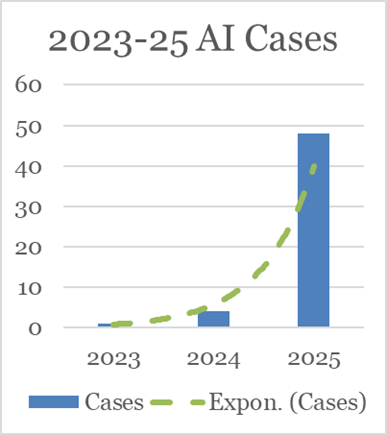
Since the launch of ChatGPT in late 2022, the use of generative artificial intelligence (GenAI) in Australian court proceedings has significantly increased, with a marked escalation in 2025. While instances of problematic GenAI use have involved self‑represented litigants, several legal practitioners have also been subject to judicial scrutiny, including where AI‑generated content was filed without adequate verification.
The graph above represents an exponential increase in decisions involving AI-related hallucinations, including cases that involve self-represented litigants. The most common action from courts in response to the inappropriate use of AI have been costs orders, warnings, and disregarding hallucinated submissions. Increasingly, courts are also prepared to impose wasted‑costs orders on self‑represented litigants whose reliance on unverified AI has caused delay or unnecessary work.
GenAI tools have made it easier for individuals to articulate claims and rapidly commence proceedings without professional legal assistance, despite the fact these tools continue to display well‑documented limitations in legal research and citation accuracy. This trend is likely to contribute to higher volumes of general disputes litigation, particularly in consumer and commercial matters and in high-volume jurisdictions such as the NSW Civil and Administrative Tribunal and the Fair Work Commission. Relevantly, there has already been an almost 50% increase in lodgements to the Fair Work Commission in 2024-25 compared to 2020-21, with 44,075 claims lodged overall.
Court Guidelines – Update for legal practitioners
As discussed in our AI Regulatory Horizon Tracker for Australia, a refined NSW Supreme Court Practice Note governing GenAI took effect on 3 February 2025.
The Practice Note implements strict rules governing GenAI assisted legal work. It prohibits the use of gen AI to generate the content of affidavits, witness statements, and character references. It also requires that any legal citations, authorities or references generated with AI be independently verified for accuracy and relevance and that such verification not be solely carried out by using AI itself.
These rules sit alongside broader warnings about risks including hallucinations, confidentiality breaches, and data retention by AI platforms.
The Law Council of Australia has made submissions to the Federal Court of Australia regarding the use of AI in the Court. The Judges of the Federal Court are considering the development of Guidelines or a Practice Note regarding the use of GenAI by practitioners and court users. On 21 November 2025, in his opening address to the Australian Legal Convention, Chief Justice Gageler of the High Court emphasised that the “Australian Judicature has no option to engage” with the use of AI—acknowledging both its inevitability and the need for professional safeguards.
Separately, on 25 November 2025, the Australian Government announced that it will be establishing an Australian Artificial Intelligence Safety Institute, signalling an impending regulatory framework for safe AI adoption across sectors, including legal practice. For more information, see our article which can be found here.
Developments in opt-out class action procedures
Due to Australia’s opt-out class action proceedings, determining the size and composition of a class at the outset is difficult. To solve this issue, parties can seek “soft” class closure orders. These encourage class members to proactively register their claims within a certain timeframe if they wish to benefit from any settlement. However, there has been a long-standing inconsistency on whether courts have power to issue soft class closure orders.
This was resolved in Lendlease Corporation Ltd v Pallas [2025] HCA 19, where the High Court of Australia made it clear that the New South Wales Supreme Court does have the power to make soft class closure orders.
This development is expected to accelerate early mediation and settlement strategies by resolving claims earlier via mediation and changes the class action landscape going forward in 2026.
Australia’s pro-enforcement approach to international arbitration
Throughout 2025, Australia continued to signal a strong pro‑enforcement stance in international arbitration, indicating a potential increase in international arbitration cases in the coming years.
The International Arbitration Act 1974 (Cth) underlies Australia’s enforcement framework, ratifying the New York Convention on the Recognition and Enforcement of Foreign Arbitral Awards 1958 and the Convention on the Settlement of Investment Disputes between States and Nationals of Other States (ICSID Convention). Under section 9 of the Foreign State Immunities Act 1985 (Cth) (Immunities Act), foreign states are typically immune from Australian jurisdiction, unless the state submits to Australian jurisdiction “by agreement or otherwise”.
In Blasket Renewable Investments LLC v Kingdom of Spain (relief) [2025] FCA 1469, the Federal Court of Australia upheld the enforceability in Australia of four intra-EU ICSID awards under the Energy Charter Treaty against Spain. The Court rejected Spain’s arguments that:
- it had not waived immunity,
- EU law superseded the ISCID Convention,
- EU member states had made inter se modifications to the ICSID Convention, and
- the award assignments were invalid.
This decision highlights the attractiveness of Australia as a potential jurisdiction for the enforcement of ICSID awards and for arbitration generally. We note, however, that the Kingdom of Spain has confirmed its intent to appeal this decision.
We are continuing to closely monitor this case and its impact on the arbitration environment in Australia.
As these forces reshape the litigation landscape, organisations that proactively adapt will be best placed to navigate complexity with confidence. To explore how these trends may impact your business in 2026, reach out to our team for tailored guidance.
This article was co-authored by Jonathon Ellis, Jonathan Tay, Madelaine Morgan, Charlotte Ainsworth and Hayley Dobbin