Environmental labelling: a new tool for more sustainable fashion
Contacts

Partner
France
I'm a partner in our international Commercial group, based in Paris, where I provide our clients with strategic commercial advice.

Associate
France
I am a junior associate, with experience advising clients on regulatory matters across several sectors, especially in life sciences, food and beverages, and environmental sectors.

The decree and order relating to the labelling of the environmental footprint of textile products have finally been published, establishing the display requirements and methodology for calculating and communicating the environmental impact of textile clothing.
Their publication is part of a long-standing effort to better inform consumers about the environmental impact of products and thus promote more responsible purchasing choices.
A legal framework derived from the Climate and Resilience Act
Environmental labelling finds its legal basis in the Climate and Resilience Act, which introduced it into the Environment Code. This law lays the groundwork for experimentation and the subsequent widespread adoption of environmental labelling for specific product categories.
The published texts thus establish the legal framework for textile clothing with the aim of future generalisation to other sectors, in particular the food sector.
For the time being, this framework applies to new or remanufactured clothing textiles1 placed on the national market for consumers.
Principle and methodology: a voluntary but regulated approach
Starting 1 October 2025, manufacturers, importers or distributors of clothing will have the option to display the environmental impact of their products. If they choose to do so, they must adhere to the requirements specified in the decree and follow the methodology outlined in the corresponding order.
The environmental impact must be displayed on the product itself, on the shelf, or online, and must be accessible at the time of purchase.
This information should be presented using standardized signage that indicates the number of impact points, calculated based on a life cycle assessment (LCA)2. This methodology considers several environmental indicators, including:
- consumption of water and other natural resources,
- modes of transport used to make the product available to consumers,
- greenhouse gas emissions, or damage to biodiversity.
The higher the score, the greater the "ecological price" of the product.
This method is largely based on European research on the Product Environmental Footprint (PEF) assessment method. The French system has adapted it to include additional criteria such as microfibre emissions (during product washing), recycling potential, microplastic fibre discharge, and the breadth of a brand's product range.
Those who voluntarily participate in this initiative will also be required to comply with reporting obligations. Certain data, such as the breakdown of environmental costs by impact category and the date on which the environmental cost calculation was performed, must be made public on the official portal affichage-environnemental.ecobalyse.beta.gouv.fr.
The underlying calculation data must also be reported but will only be accessible to authorised agents.
The supporting documents used for calculation must also be made available to the authorities and presented in the event of an inspection.
Although environmental labelling remains voluntary, despite the original legislative intent to make it mandatory, penalties apply in cases of non-compliance for those who choose to implement it3.
Calculation tools and labelling rules
Tools are available to support operators who choose to communicate this cost, including a methodological guide for calculating the environmental impact, and a digital portal " Ecobalyse ", which allows to calculate the environmental cost free of charge.
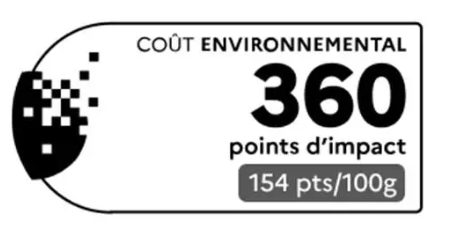
A graphic charter has also been developed to define the conditions for displaying environmental information on textile product labels, on shelves, in communication materials and online. This labelling, consisting of the words "Environmental cost" and a pictogram indicating the number of impact points calculated, as well as the same number of points relative to the mass of the product concerned and expressed per 100 g, must be visible and legible while complying with certain size requirements.
It will take the following form:
Strategic prospects and challenges for businesses
The textile sector is thus establishing itself as a pioneer in environmental labelling in France. Although this labelling remains voluntary, it reflects a dynamic that is set to be gradually extended to other product categories (food, furniture, household appliances, cosmetics, etc.) thereby paving the way for the widespread adoption of the system.
By making the ecological impact of products visible, this system pursues two objectives: to guide consumer choices towards more environmentally friendly clothing and to encourage businesses to reduce the environmental footprint of their products.
Companies that adopt this proactive approach gain significant competitive advantages: enhanced trust from consumers who are increasingly sensitive to environmental criteria, strengthened recognition of their ESG commitments, and anticipation of future regulatory obligations. Several brands have already communicated on their adoption of environmental labelling.
_____________________
1 - Within the meaning of Regulation (EU) No. 1007/2011 of 27 September 2011 on textile fibre names and related labelling and marking of the fibre composition of textile products.
2 - The life cycle includes, in particular, the stages of raw material production, processing, distribution, use and end of life.
3 - In accordance with Articles L. 541-9-14 and L. 541-9-15 of the Environment Code, in the event of non-compliance with the calculation and communication requirements, an administrative fine may be imposed. The amount of this fine may not exceed €3,000 for a natural person and €15,000 for a legal person